Space Planning & Buying
The Office for Life Warranty: What a Lifetime Structural Warranty Covers
Arc Grove backs every desk, table, cabinet, and shelf with the Office for Life warranty: lifetime structural cover, plus tiers...
Read more →
Space Planning & Buying
A cohesive office looks designed, not assembled. It comes from repeating one wood tone, one metal, one palette, and one design language across every room.

A cohesive office looks designed; a patchwork one looks assembled, even when every piece is nice. The difference isn't that everything matches, it's that a few things repeat: one wood tone, one metal, one palette, and one design language, carried from reception through every room. Cohesion is repetition, not uniformity, and once you see it that way it's straightforward to achieve. Here's how.
The reason it matters is simple: a visitor reads the whole office as one impression, not room by room. When the reception, the boardroom, and the workstations clearly belong to the same idea, the space reads as considered and well-run. When they don't, it reads as a series of separate decisions, which is exactly what it was.

The goal isn't to make every room identical, which would be dull. It's to run a few consistent threads through spaces that can otherwise be quite different. A reception desk and an open-plan workstation don't need to look the same, but if they share the same wood tone and the same accent colour, the eye connects them. Pick the threads to repeat, then let each room express them in its own way. That's the whole discipline.
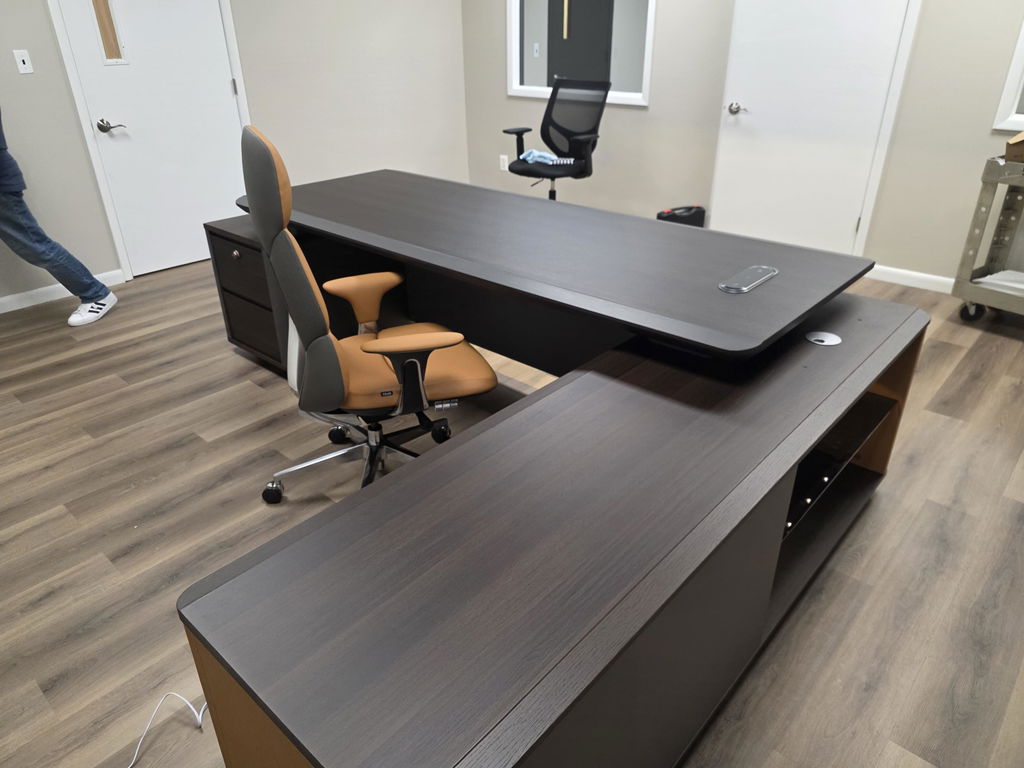
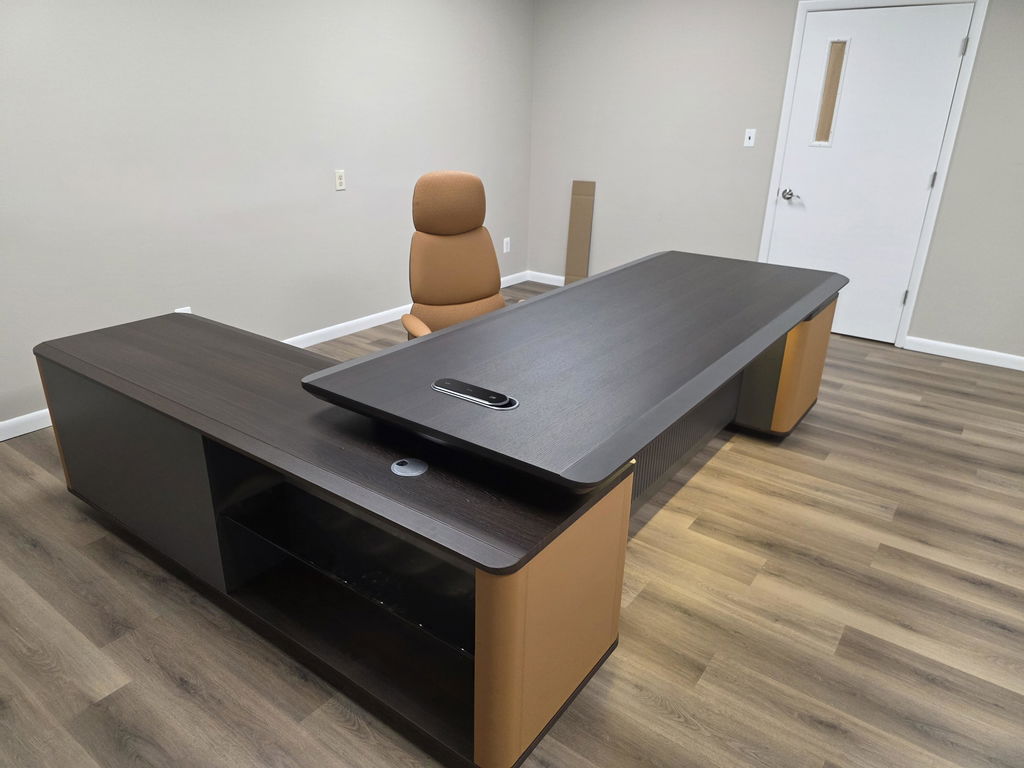
Start with the finishes, because they carry cohesion further than anything else. Choose one wood tone and one metal, and hold them across the desks, the storage, the reception, and the conference tables. Add one or two accent colours drawn from your brand, and use them consistently, on the seating, the screens, the soft furnishings, so the palette recurs wherever you look. Our guide to choosing your office finishes covers building that palette; the key here is using the same one everywhere.

Beyond the finishes, commit to one register and keep it. If the office is transitional, warm wood with clean lines, then reception, the executive suite, and the meeting rooms should all read transitional, not modern in one room and traditional in the next. The style can flex in intensity, a boardroom can be more formal than the workstation floor, but it shouldn't change species. That consistency of language is what makes a large office feel like one place rather than several.
Reception is where a visitor first reads the office, so let it establish the palette and the register, then echo that thread through everything behind it. The wood on the reception desk shows up again on the boardroom table; the accent colour reappears on the workstation screens and the lounge seating. Our guide on how a reception area reflects your brand covers setting the tone; cohesion is simply carrying that tone all the way through.
The easiest way to get all of this is to specify the whole office from one supplier, in one palette, at once. When the desks, storage, reception, conference, and workstations are built together in a shared finish, cohesion is automatic rather than something you have to engineer across a dozen separate orders. It's the practical reason a coordinated fit-out looks more expensive than the sum of its parts.
Cohesion is far easier to plan in than to retrofit. Arc Grove® builds every room of an office, reception, executive, conference, storage, and workstations, in coordinated finishes, so the whole space reads as one. Plan a coordinated office, or see how the pieces come together in our guide to designing an executive office.
Related articles
Space Planning & Buying
Arc Grove backs every desk, table, cabinet, and shelf with the Office for Life warranty: lifetime structural cover, plus tiers...
Read more →
Space Planning & Buying
Contract-grade furniture is built and tested for continuous commercial use, evidenced by ANSI/BIFMA testing. What it means, and why it's...
Read more →
Space Planning & Buying
Quickship pieces arrive in 8–14 days from our US warehouse; made-to-order fits exactly but takes 5–12 weeks. When each makes...
Read more →