Executive Desks & Offices
Veneer, Solid Wood & Stone: A Guide to Premium Desk Materials
At the executive level, the material makes the desk. What distinguishes wood veneer, solid wood, and stone, and how to...
Read more →
Matching Sets
Executive Desks & Offices
A full-height bookcase wall is the biggest visual move in an executive office, and the most underused. How to size it, style it, and match it to your desk.

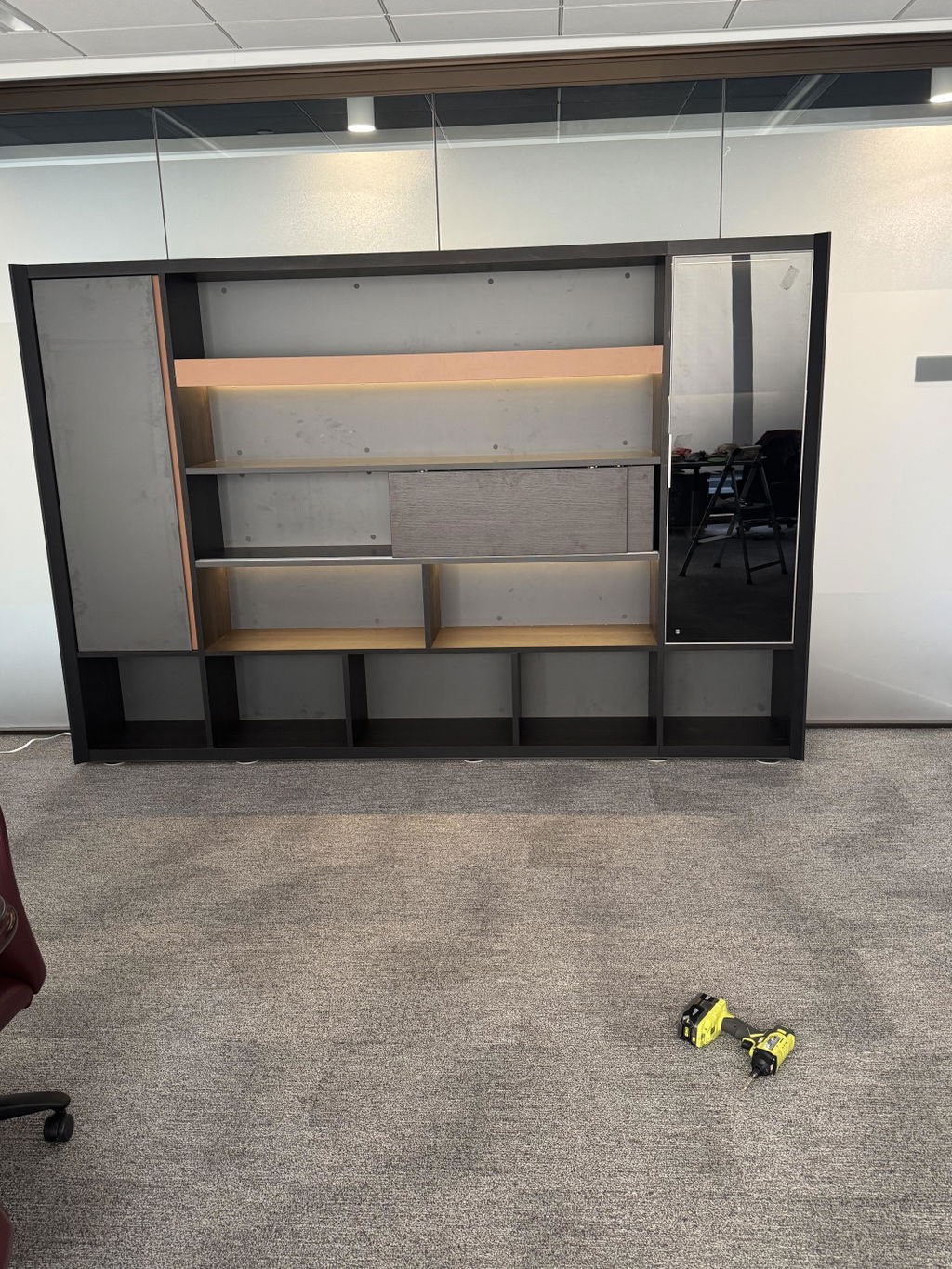
A full-height bookcase or shelving wall is the single biggest visual move in an executive office, and the most underused. Run floor to ceiling on the wall the desk faces or backs onto, it holds books and objects, hides what a desk can't, quiets the room, and does more for the sense of a designed space than any other piece. Here's how to get it right.
Most offices treat storage as an afterthought, a low cabinet in a corner. That's a missed opportunity. A proper wall of shelving is what turns a room with a nice desk into a room that looks composed, and it earns its footprint three times over.
Height is what does the work. A floor-to-ceiling run draws the eye up and frames the desk like a backdrop, where a half-height cabinet just fills the lower wall and leaves the top blank. It gives you display at eye level, closed or deep storage lower down for the things a desk can't hide, and a single architectural gesture that reads as intentional. On video calls it's the best backdrop in the room, structured, personal, and impossible to fake with a virtual background.

Scale it to the wall, not the clutter. Take the shelving as close to the ceiling as the room allows so there's no dead band along the top, and let it run the full width of its wall or sit centered and balanced, not marooned to one side. About 12 to 16 inches of depth handles books and objects without eating the floor; deeper bays lower down take files, boxes, and the printer. If the wall has a door or window, wrap the shelving around it rather than stopping short, that's what makes it read as built-in.
The mistake is filling every shelf. Aim for roughly two-thirds occupied, one-third breathing room: books grouped by color or subject, a few objects with weight, some open space so the eye can rest. Mix horizontal stacks with vertical runs, leave the odd shelf nearly empty, and keep the busiest material, paperwork and binders, behind closed fronts down low. A styled wall says considered; a stuffed one says storage.

This is what separates a designed room from a furnished one. Carry the same wood tone and hardware from the desk to the shelving so the two read as one suite, not two purchases. A walnut desk wants walnut shelving; a pale oak desk wants the wall to echo it. When the finishes match, even a modest office looks pulled together; when they clash, an expensive one looks assembled from a catalog.
A wall of shelving filled with books and objects is also the most attractive sound absorber you can own. Hard, empty offices bounce sound and make calls feel echoey; the varied depths of a loaded bookcase break up those reflections and take the hard edge off the acoustics. It's a real, if quiet, benefit of choosing storage that displays rather than storage that hides.
Walls are rarely a standard size, which is why stock shelving so often stops short or overshoots. Arc Grove® builds shelving and storage to exact width and height, in a finish matched to your desk, so the wall fits floor to ceiling and edge to edge. Build your bookcase wall, or see how it anchors the room in our guide to designing an executive office.
Related articles
Executive Desks & Offices
At the executive level, the material makes the desk. What distinguishes wood veneer, solid wood, and stone, and how to...
Read more →
Executive Desks & Offices
With more than 150 finishes to choose from, the way to a coordinated office is a simple sequence: pick one...
Read more →
Executive Desks & Offices
A home executive office should be as considered as the one at headquarters. How to design a serious, presence-carrying space...
Read more →