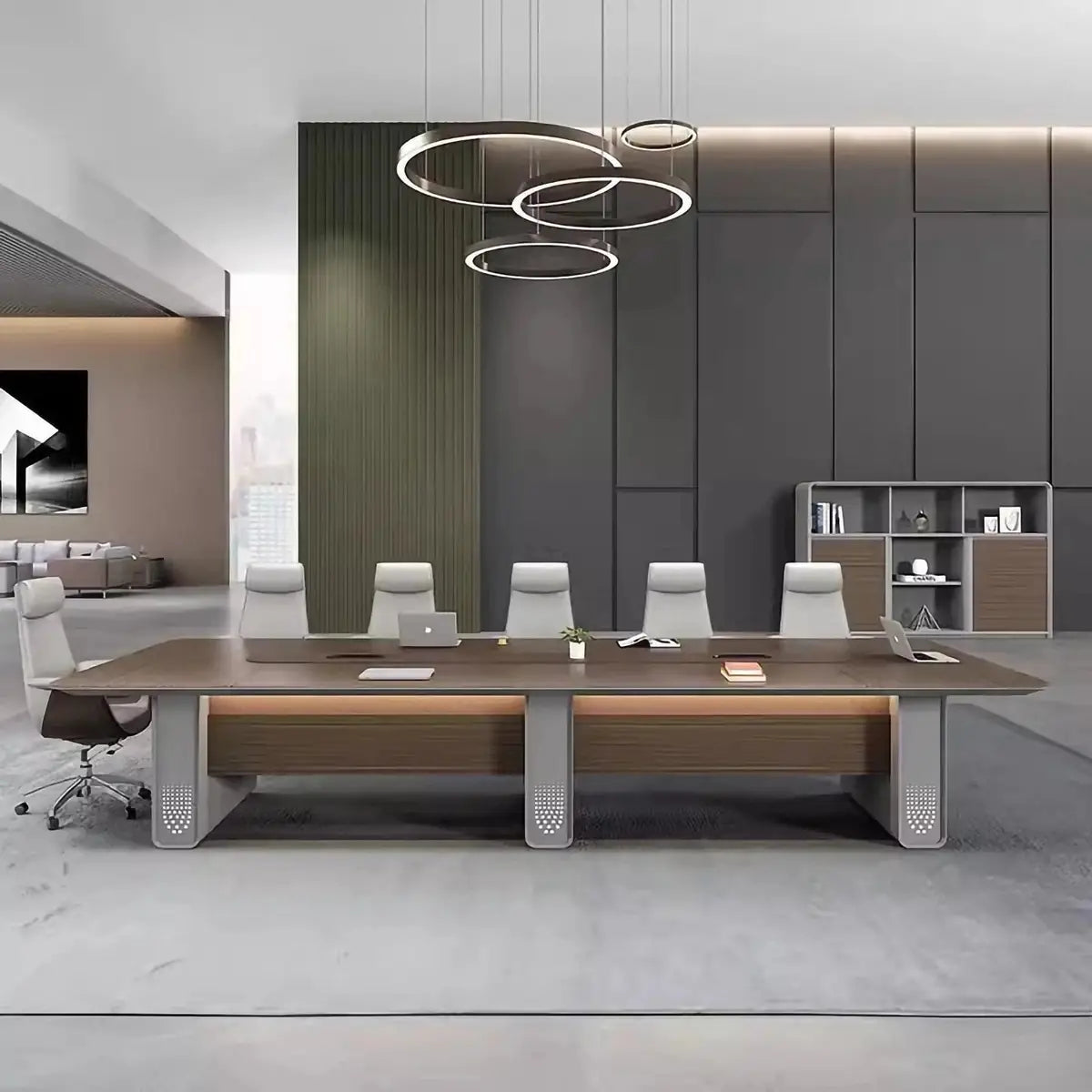
Planning Your Office: Conference Room Sizes That Work
Conference rooms are sized to the meeting. Small rooms (120–168 sq ft) seat 4 to 6; medium (252–320 sq ft) seat 8 to 10; large (432–572 sq ft) seat 12 to 16; boardrooms (720+ sq ft) seat 18 or more. Plan roughly 20 to 25 square feet per person, a 36-inch door, and at least 36 inches of clearance behind seated chairs.
Conference room size shapes everything about how a meeting runs — sightlines, acoustics, who speaks up, how fast decisions move. Get the dimensions wrong and a room feels either cramped and contentious or empty and impersonal. Get them right and the space disappears so the people in it can think. This guide gives precise dimensions, per-person clearances, and seating for four room sizes — small, medium, large, and boardroom — plus the right table and chairs for each.
Conference room size comparison
A common industry planning convention allows 20 to 25 square feet per person for a standard conference room and 25 to 30 for an executive boardroom. Doorways should be at least 36 inches wide (ADA), and circulation behind seated chairs needs at least 36 inches — preferably 48 — so people can stand and pass without disrupting the room.
Conference room sizes at a glance
| Room category | Dimensions | Total area | Capacity | Table length | Best uses |
|---|---|---|---|---|---|
| Small | 10×12 to 12×14 | 120–168 sq ft | 4–6 people | 5–7 ft | Interviews, 1-on-1s, focused huddles |
| Medium | 14×18 to 16×20 | 252–320 sq ft | 8–10 people | 8–10 ft | Team meetings, client pitches, training |
| Large | 18×24 to 22×26 | 432–572 sq ft | 12–16 people | 12–16 ft | Department reviews, all-hands, workshops |
| Boardroom | 24×30 to 30×40+ | 720–1,200+ sq ft | 18–28+ people | 18–26+ ft | Board meetings, executive sessions |
No building code sets a comfort minimum for conference rooms. The one authoritative figure is the IBC occupant-load factor — 15 net square feet per person for a tables-and-chairs space — but that is a life-safety maximum density, not a comfort target. The familiar 20 to 25 square feet per person is industry planning convention.
IBC 2021 — Table 1004.5, occupant load
Small conference rooms (10×12 to 12×14)

Small conference rooms are for high-context conversations — interviews, status check-ins, decisions among four to six people who already know each other. The room should feel close enough for natural conversation but not so tight that anyone feels trapped.
Dimensions and clearances
- Room footprint: 10×12 to 12×14 ft (120–168 sq ft)
- Table size: 5–7 ft long × 36–42 in wide
- Per-person allowance: about 20 sq ft
- Behind seated chairs: 36 in minimum to wall (pushback and standing)
- Doorway: 36 in wide, positioned away from the head of the table
- Per-person table edge: 24 in minimum, 30 in comfortable
Seating recommendation
Mid-back ergonomic task chairs with a five-wheel base, mesh or upholstered seat, and adjustable arms. Skip the high-back executive look here — it overwhelms the room and signals more formality than the conversation needs. Keep the footprint compact so people can rotate without colliding.
Table and tech
- Rectangular or boat-shaped table with a hidden cable grommet and at least one power/USB module
- A 32 to 55 in wall-mounted display in line with the long edge of the table
- A single conference camera or USB webcam — no multi-mic array needed at this scale
- HDMI plus wireless presentation (one connection point at the head of the table)
Shop the right size: tables seating up to 6 · 5–6 ft tables
Medium conference rooms (14×18 to 16×20)

The medium conference room is the workhorse of most offices — sized for the recurring team meeting, the prospect pitch, the cross-functional review. Enough room to set up a presentation without feeling like a stage, intimate enough that no one in the back checks out.
Dimensions and clearances
- Room footprint: 14×18 to 16×20 ft (252–320 sq ft)
- Table size: 8–10 ft long × 42–48 in wide
- Per-person allowance: 22–25 sq ft
- Behind seated chairs: 42–48 in to wall (visitors pass without contact)
- Display wall clearance: 4–5 ft from table end to screen so the front row can read it
- Per-person table edge: 30 in comfortable, 36 in generous
Seating recommendation
Mid-back executive or premium task chairs with adjustable lumbar, height, and arms. Meetings this size routinely run 45 to 90 minutes, so chairs need to hold up for the whole runway. Match the chair finish to the table tone rather than mixing materials.
Table and tech
- Rectangular or boat-shaped table with two power/data modules (one per side)
- One 65 to 75 in display, or dual side-by-side 55 in displays for hybrid meetings
- A wide-angle PTZ conference camera plus a ceiling or tabletop mic array
- A wireless presentation system with a wired backup at the head of the table
Shop the right size: tables seating up to 8 · up to 10 · 8–9 ft tables
Large conference rooms (18×24 to 22×26)

Large rooms host department-wide meetings, training, and workshops. Sightlines and acoustics start to matter more than intimacy — anyone at the far end has to hear, see, and be seen clearly. Plan for both primary table seating and overflow along the walls.
Dimensions and clearances
- Room footprint: 18×24 to 22×26 ft (432–572 sq ft)
- Table size: 12–16 ft long × 48–54 in wide
- Per-person allowance: about 25 sq ft (factor in overflow and AV)
- Behind seated chairs: 48 in minimum, 60 in for ADA wheelchair turning
- Primary circulation aisle: 44 in wide
- Per-person table edge: 30–36 in
Seating recommendation
Mid- to high-back executive chairs with arms at the primary table, plus a row of side chairs along one wall for overflow. The primary chairs should match across all seats — visual consistency reads as professionalism at this scale. Choose casters, not glides, so people can reposition without lifting.
Table and tech
- Racetrack, rectangular, or modular table with power/data every two seats
- Dual 75 in+ displays at the front, or a single 98 in display with a confidence monitor at the back
- A ceiling mic array (not tabletop) for even coverage regardless of who is leading
- A PTZ camera with auto-tracking and a dedicated room-control system
- Acoustic panels on 20 to 30% of wall surface — large rooms get echoey fast without treatment
Shop the right size: tables seating up to 14 · up to 16 · 14–15 ft tables
Boardrooms and executive conference spaces (24×30 and larger)

The boardroom is the room everything else gets compared to. Material quality, finish, and proportion all carry weight — clients, investors, and partners read the room before the first slide loads. Spend the budget here on table presence and chair quality; the technology should be excellent but invisible.
Dimensions and clearances
- Room footprint: 24×30 ft and up (720+ sq ft)
- Table size: 18–26+ ft long × 54–60 in wide
- Per-person allowance: 25–30 sq ft
- Behind seated chairs: 60 in minimum for full pushback and wheelchair turning
- Head of table to display wall: 8–12 ft so the principal has presentation room
- Per-person table edge: 36 in minimum
Seating recommendation
High-back executive chairs in premium leather or structured upholstery, identical across all primary seats. The head-of-table seat can be distinguished by scale — a slightly taller back, a larger frame — but should match the material and finish: distinction without inconsistency. Plan one or two side chairs against a credenza wall for advisors and observers.
Table and tech
- Boat-shaped or oval table — both give every seat a clear sightline to both ends
- Premium materials: solid wood, stone, lacquer, or matte veneer over a hardwood substrate
- Integrated power, data, and confidence-monitor pop-ups every two seats
- A 120 in+ projection or video wall, plus a confidence monitor recessed at the head
- Full DSP audio with multiple ceiling mic zones and camera tracking for hybrid attendees
Shop the right size: tables seating up to 18 · luxury conference tables
Quick-reference clearance chart
Conference room clearances
| Clearance type | Minimum | Recommended | Why |
|---|---|---|---|
| Behind seated chair to wall | 36 in | 48 in | Pushback and standing room |
| Behind seated chair, ADA | 60 in | 60 in+ | Wheelchair turning radius |
| Per person at table edge | 24 in | 30–36 in | Materials and elbow room |
| Primary circulation aisle | 36 in | 44 in | Walk-through during meetings |
| Door width | 36 in | 36 in | ADA compliance |
| Table end to display wall | 4 ft | 5–8 ft | Readability for front-row seats |
Final thoughts
The right conference room is sized to its actual job. A small room with the wrong dimensions feels uncomfortable; a large room overspecified for the meetings it hosts feels empty and unfocused. Lead with the meetings you actually run, then size the room — table, chairs, displays, and clearances — around them. When you are ready to specify the table, the conference tables collection filters by exact length, capacity, finish, and built-in features — or any table can be built to your room’s exact dimensions.
Frequently asked questions
- How many square feet does a conference room need per person?
- As a planning convention, standard rooms allow 20 to 25 square feet per person and executive boardrooms 25 to 30, to account for larger chairs, wider tables, and full circulation. A 10-person standard room therefore runs roughly 200 to 250 sq ft. These are rules of thumb, not code — the only authoritative figure is the IBC’s 15 net sq ft per person, a maximum-density limit rather than a comfort target.
- What is the standard width of a conference table?
- Width (the short dimension) typically runs 36 to 60 inches. 36 to 42 inches suits small huddle rooms; 48 inches is the executive standard for medium and large rooms — wide enough for laptops, documents, and across-table conversation; 54 to 60 inches is reserved for boardrooms where presence matters as much as function.
- How much space should each person have at the table?
- Allow 24 inches minimum, 30 inches for comfort, and 36 inches for executive seating. Per-person width decides whether people feel like they are sharing the table or fighting for it — under-spec it and even a beautiful room reads as crowded.
- What is the right clearance behind seated chairs?
- 36 inches minimum so anyone can stand and push their chair back; 48 inches so a colleague can walk behind without anyone moving; 60 inches for the ADA wheelchair turning radius — plan that into any new build, not just the rooms you label accessible.
- What is a conference-style layout?
- A single central table with chairs on all sides, typically rectangular, boat-shaped, or oval. It prioritizes face-to-face discussion and equal participation over presentation-to-audience formats like classroom or theater seating — the right choice when the outcome depends on dialogue, not delivery.
- How do I choose between rectangular, boat-shaped, and racetrack tables?
- Rectangular tables seat the most per linear foot and suit most rooms. Boat-shaped tables bow outward in the middle so people at the ends can see each other and the display — ideal for boardrooms and video calls. Racetrack tables (rounded ends) soften the look and ease circulation around the corners, a good fit for large rooms. Round tables suit small rooms of four to six where equal participation matters most.
Other Articles
15+ Reception Desk Design Ideas from Arc Grove
Top 10 Best L-Shaped Desks for Your Office
Modular Office Furniture: Smart Workspace Solutions